Black — why do brands remove colour when they become more confident?
Black is one of the most frequently used colours in branding, yet it is rarely discussed in the same way as red, blue, or green. Unlike colours that are often associated with specific emotions or industries, black occupies a more ambiguous position. It can signal luxury and authority, but also restraint and neutrality. It can feel timeless, modern, formal, rebellious, or understated depending on the context in which it appears.
Perhaps this is why black remains one of the most enduring colours in visual identity. While design trends come and go, black continues to survive almost every shift in branding. The more interesting question, however, is not why brands use black. It is why so many brands eventually move towards it.
The absence of colour
Unlike most colours, black is often defined by what it lacks rather than what it contains.
In colour theory, black is frequently described as the absence of light. In branding, it often functions in a similar way. Rather than adding meaning, black removes distractions. It strips away associations that other colours inevitably carry. This ambiguity gives it a unique advantage. It allows a brand to place greater emphasis on form, typography, proportion and composition rather than colour itself. When colour is removed, other elements of the identity are forced to carry more meaning.
In many ways, black does not compete for attention, It redirects it.
The relationship between confidence and restraint
One of the most noticeable patterns in branding is that established organisations often simplify their visual language over time.
This does not mean that every mature brand becomes black, but many begin reducing visual complexity. Colours become fewer. Logos become simpler. Decorative elements disappear. Why, you may ask, because confidence changes how communication works.
New brands often need to explain themselves. They seek attention, differentiation and visibility. Established brands already possess recognition. Their challenge is not to be noticed, but to remain recognisable. The dynamics are different. When a brand is unknown, it often speaks loudly. When a brand becomes familiar, it no longer needs to.
This is one reason why black appears so frequently among luxury houses, fashion brands and globally recognised companies. The colour does not need to persuade. It assumes the audience is already listening.

Modernism and the pursuit of clarity
The rise of black in contemporary branding is closely connected to modernist design principles. Throughout the twentieth century, designers increasingly sought systems that prioritised clarity, function and consistency. Ornamentation gave way to structure. Expression became secondary to communication. Within this framework, black became a natural choice.
Typography could be reproduced consistently across different media. Logos became more flexible. Identities became easier to scale internationally.
Designers such as Massimo Vignelli frequently advocated reduction as a way of improving communication. Their goal was not aesthetic minimalism for its own sake, but the removal of unnecessary visual noise. Black fit naturally into this philosophy because it allowed structure to become visible. Rather than drawing attention to itself, it emphasised the system around it.
Black as a symbol of authority
There is also a cultural dimension to black that extends beyond design.
Throughout history, black has been associated with authority, formality and status. Judges’ robes, formal attire, luxury products and high-end publishing have all relied on black as a marker of seriousness and control. Unlike brighter colours, black rarely appears playful. It suggests discipline. This partly explains why luxury branding has embraced black so consistently. Brands such as Chanel, Prada and Saint Laurent often rely on monochromatic visual systems where typography and composition carry the identity. In these cases, colour is not used to attract attention. Scarcity becomes the message.
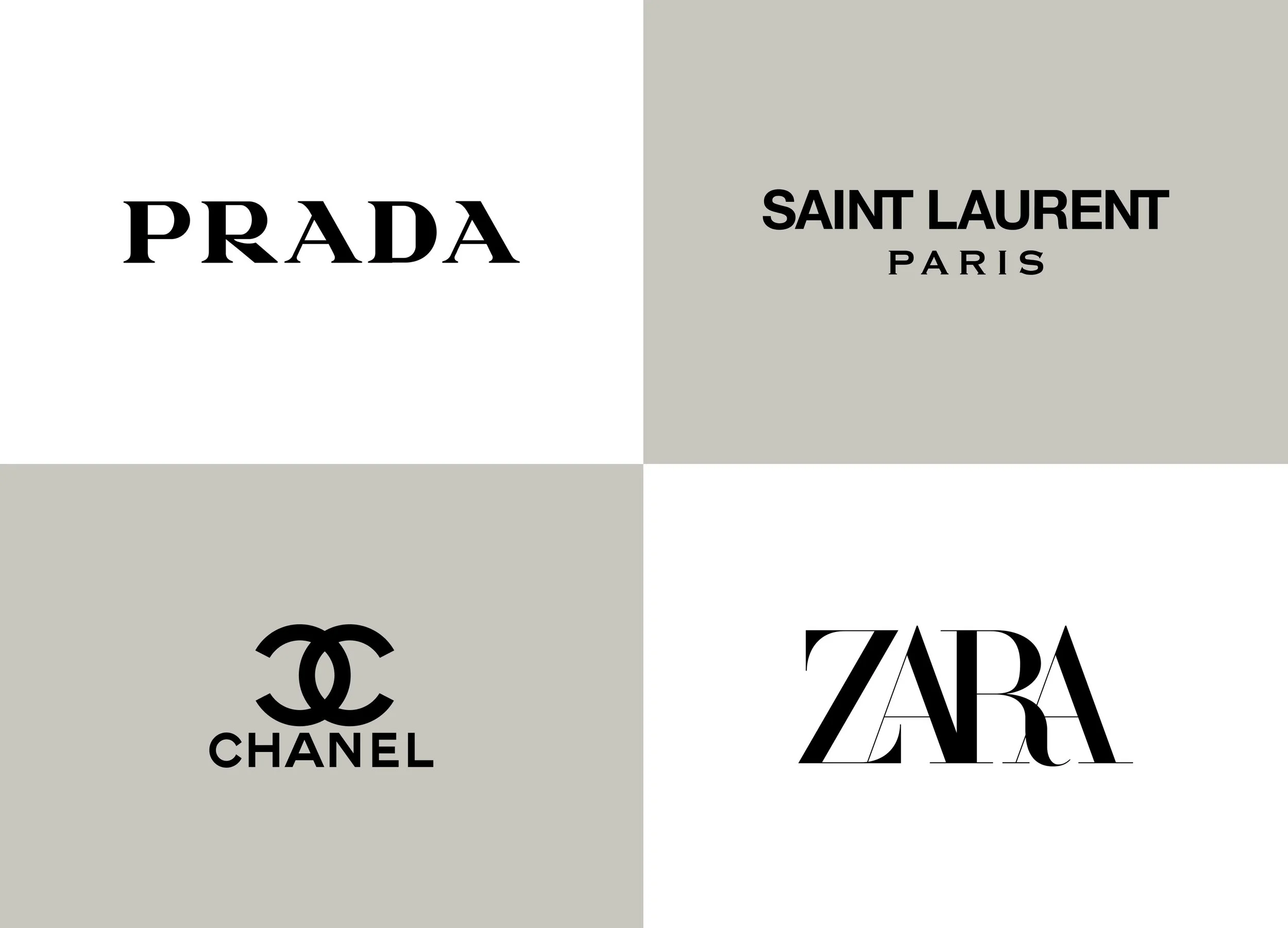
Black logos: Prada, Saint Laurent, Chanel and Zara.
The digital paradox
Interestingly, black has become even more prominent during the digital era. At first glance, this seems counterintuitive. Digital environments reward visibility. Social media platforms, notifications and advertisements compete aggressively for attention through colour, motion and contrast. Yet many brands have moved in the opposite direction. As visual environments become noisier, restraint becomes more valuable. A monochromatic identity can feel distinctive precisely because it refuses to compete using the same tools as everyone else. In a landscape filled with visual stimulation, simplicity can become a form of differentiation. This mirrors a broader shift in branding. The challenge is no longer simply being seen. It is being understood. And understanding often requires less visual noise rather than more.

Black logos: Apple, WWF, Sony and The New York Times.
The limits of black
Of course, black is not universally effective. A monochromatic identity can appear cold, distant or generic if it lacks a strong underlying concept. Black does not automatically create sophistication. It merely removes one layer of communication, forcing other elements to work harder. This is why some brands successfully simplify while others become forgettable.
The difference rarely lies in the colour itself. It lies in the strength of the system beneath it. When typography, proportion, language and positioning are weak, black exposes those weaknesses rather than hiding them. In this sense, black behaves much like minimalism itself. It rewards clarity and punishes ambiguity.
Final thoughts
Black is often described as a colour of luxury, elegance or authority. While these associations are not wrong, they only explain part of its role in branding. Perhaps the reason black remains so powerful is that it asks less of colour and more of everything else. It shifts attention towards structure, proportion and meaning. It assumes that recognition can be achieved through consistency rather than decoration. And it reflects a form of confidence that many brands spend years trying to build.
This may explain why so many organisations simplify their visual identities as they mature. Not because colour loses value, but because recognition changes the rules of communication. A young brand often needs colour to be noticed. An established brand can afford to let colour step aside.