Design is often positioned as a solution — a way to clarify, improve, and elevate. When something does not work, design is brought in to fix it. A brand feels outdated, a product underperforms, a service fails to differentiate. The response is immediate: redesign.
This expectation is not accidental. Design produces visible change, and visible change is easy to interpret as progress. It reshapes what people see, how they navigate, and what they notice first, which makes it an accessible point of intervention when something feels wrong. Compared to strategy or operations, it offers something tangible — a before and after — even when the underlying issue may not actually be visual.
Clarity, visibility and the surface bias
The difficulty begins when visibility replaces understanding. Because design operates at the surface of systems, it becomes the point where abstract problems are translated into concrete form. A messaging issue becomes a typography discussion, a positioning problem becomes a logo conversation, and structural inconsistency is reframed as a visual challenge.
The assumption behind this shift is subtle but persistent: that clarity at the surface can compensate for ambiguity underneath. Yet clarity and definition operate on different levels. Design can organise information and make it legible, but it cannot define what that information should be.
This distinction is not new in design thinking. Dieter Rams’ principle that good design should be “as little design as possible” is often interpreted visually, but its functional meaning is more precise: removing what is unnecessary assumes that the essential is already defined. John Maeda makes a similar point in The Laws of Simplicity, where simplicity is described not as reduction, but as the organisation of complexity into something usable. In both cases, design operates on what exists, not on what is missing.
When design is used to compensate
In practice, design is frequently used to compensate for gaps elsewhere in the system. Products evolve without coherent structure and accumulate features that do not relate to each other. Companies expand their offering without defining internal relationships between services. Brands develop without stable positioning and rely on visual identity to hold together what is otherwise undefined.
In these cases, design is asked to create coherence rather than express it. Modernist thinking already hinted at this limitation. (Ludwig) Mies van der Rohe’s approach to reduction was not aesthetic but structural — it aimed to reveal what is already there. But when structure is absent, reduction has nothing to reveal. It only exposes the lack of definition.
Iteration without direction
When design is applied to unresolved problems, the process often moves into continuous iteration that appears productive but remains directionless. Visual systems change, styles are tested, and compositions are refined. Each version feels slightly different or improved, yet the underlying dissatisfaction persists.
This happens because iteration is operating on expression rather than definition. Without a stable conceptual foundation, each version becomes a variation of uncertainty instead of a progression towards resolution. The system moves, but the problem does not.
Design as translation, not origin
This is where the role of design becomes clearer. It is not the origin of meaning, but its translation. It converts strategy into form, structure into interface, and intention into perception. But like any translation, it depends on the clarity of its source.
Rams’ idea of removing everything that does not serve a purpose only works when that purpose is already defined. Maeda’s organisation of complexity assumes that complexity has structure. Mies’ reduction only reveals what is already present.
Design does not fail because it is weak at solving problems. It fails when it is asked to define what has not been defined.
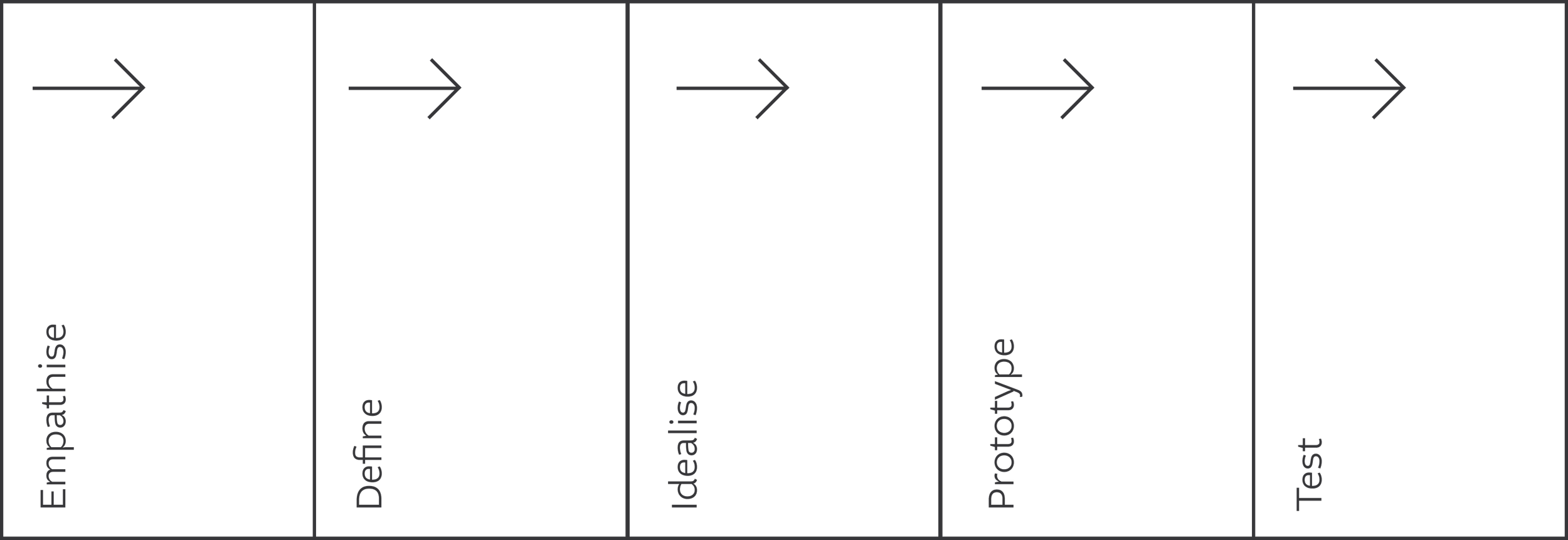
Design thinking process
The delayed cost of misalignment
The consequences of this misalignment are rarely immediate. A system can appear visually coherent while remaining structurally unclear. Over time, however, inconsistencies begin to surface — in communication, in product behaviour, and in how different parts of the system interpret the same identity.
What initially appears as a design issue reveals itself as a systemic one. The cost is not located in a single decision, but in the accumulation of small misalignments that require continuous correction.
Rethinking the role of design
Understanding this does not reduce the importance of design, but it clarifies its position. Design is most effective when it follows definition, not when it replaces it. When intent is clear, it can be structured; when relationships are defined, they can be made visible.
Without that foundation, design becomes interpretative rather than directional. And interpretation, while valuable, is not resolution.
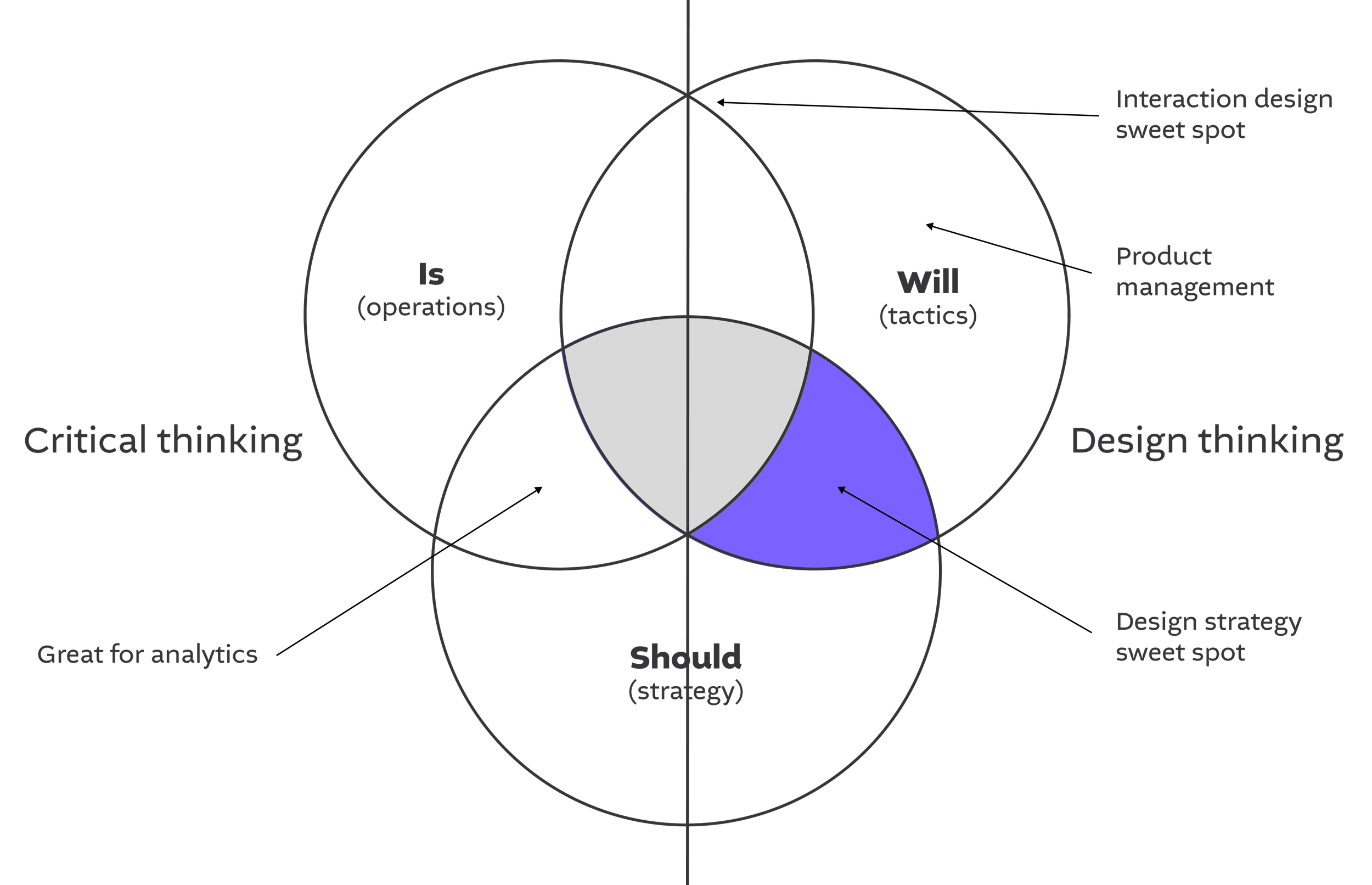
Critical thinking vs Design thinking
Final thought
Design does not fail because it cannot solve problems. It fails when it is expected to solve problems that were never clearly defined.
Its real strength lies elsewhere — in making structure visible, organising complexity, and translating intent into experience. But those capabilities only function when something intentional already exists beneath them.
This is also where the practical side of design work begins to matter more than the visual output itself. In our practice, this is why the process rarely starts with solutions or even directions. It starts with questions — often more questions than answers — and with taking time to understand what is actually being defined before anything is designed.
A brief is not treated as a fixed instruction, but as something that needs to be unpacked, challenged, and sometimes redefined together with the client. The role of design, in this sense, is not to execute assumptions, but to make sure those assumptions are clear enough to be translated in the first place. That requires dialogue, iteration in thinking before iteration in form, and a level of involvement where the client is not outside the process, but part of shaping the clarity that design eventually works with.
When that foundation exists, design can do what it is meant to do: not compensate for uncertainty, but give structure to something that has been properly understood.
